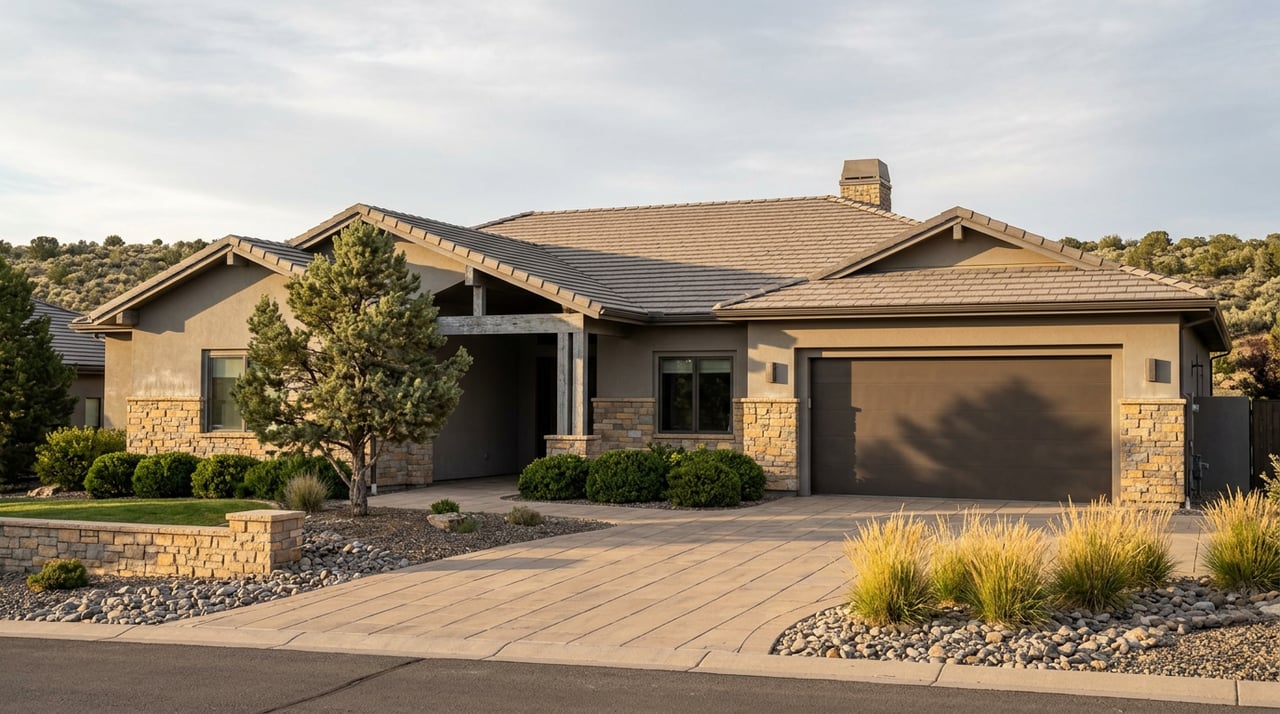
Pull up three different home-value sites for the same ArrowCreek address on the same afternoon and you will get three different numbers, sometimes separated by hundreds of thousands of dollars. That is not a glitch. It is the market telling you something true about how ArrowCreek actually trades, and it is worth understanding before you price a listing or make an offer behind those gates.
Here is what that disagreement looked like this year. In January 2026, the median sale price across ArrowCreek came in at $2.3 million, up nearly 28 percent from a year earlier. Seven months later, by August 2026, the average sale price had dropped to $1.5 million, down almost 32 percent year over year. A separate tracking site's trailing twelve-month figure landed at $1,992,500, up 5 percent, while that same site's own numbers on a different page put the median closer to $2.1 million, up 11 percent. A third source, updated in January 2026, put the median lower still, at roughly $1.55 million.
Four numbers, four different windows of time, and a spread of more than $700,000. If you are trying to figure out what your ArrowCreek home is worth, or what a home you want to buy is actually likely to sell for, none of those headline figures is lying to you. They are all measuring something real. They just are not measuring the same thing, and the reason why says a lot about how this particular neighborhood behaves.
Why the Numbers Won't Sit Still
Start with volume. ArrowCreek sold five homes in January 2026, down from fifteen the year before. When your entire dataset for a month is five sales, one $3.5 million custom estate closing next to two $1.4 million resales can swing a median by hundreds of thousands of dollars. Compare that to a neighborhood with 60 or 80 closings a month, where an individual sale barely moves the number. In ArrowCreek, each closing carries outsized weight, and a website pulling its snapshot on a different week of the month can land on a meaningfully different figure without anyone doing anything wrong.
Then there is the housing stock itself. ArrowCreek is not a subdivision of five or six repeated floor plans with a few finish-level tiers. It is a collection of custom and semi-custom builds, and the differences are not cosmetic. In the Granite Pointe enclave you will find a fully renovated single-story home on a quiet cul-de-sac. A few streets over on Nambe Drive, listings have included a half-acre custom estate with sweeping mountain views. Painted Vista has held family-style four-bedroom homes on private lots, while new construction on other streets has arrived with eight-car garages and finish packages that run past half a million dollars in upgrades alone. An automated valuation model works by finding comparable recent sales and averaging them. When the housing stock itself refuses to be comparable, the algorithm is guessing, and different platforms guess differently.
Days on market tells the same story from another angle. One tracking site's overview page describes ArrowCreek homes selling in about 126 days on average, while its own market trends chart lists a median of 54 days, down from 65 the year before, a figure that likely reflects a shorter, more recent slice of closings rather than the full annual pattern. A different site puts the average closer to 105 to 107 days. The specific day count moves depending on which window you check, but the pattern underneath it does not: ArrowCreek homes consistently sit on the market roughly twice as long as the broader Reno-Sparks average. That is not a red flag. It is what a thin, high-price, custom-home market looks like when it is functioning normally. Fewer buyers can afford to shop here, and the ones who can are comparing ArrowCreek to other beautiful homes, not rushing a decision.
The Second Invoice Nobody Prices In
Every ArrowCreek home carries a monthly HOA due, and depending on the specific gated enclave, that figure runs roughly $380 to $392 a month. That fee covers 24-hour guard-gated security, common-area landscaping, maintenance of ArrowCreek's 525 acres of open space and more than 30 miles of trails, and access to the Residents' Center, which includes three swimming pools, a year-round hot tub, a fitness room, tennis and pickleball courts, bocce, basketball, and playgrounds.
What that HOA fee does not cover is golf, and this is where out-of-area buyers most often get surprised. ArrowCreek is frequently described as a golf community, which is accurate, but golf access here runs through a separate private club membership with its own initiation cost and ongoing dues, entirely apart from what the HOA collects. A buyer who assumes the monthly HOA check includes tee times is going to be wrong, and a seller who markets a home as being in a golf community without clarifying that distinction is setting up a conversation that should have happened before the first showing.
Before you close on anything here, ask for the resale certificate, sometimes called an estoppel letter, which Nevada requires under the state's HOA statute and which will show current dues, any pending special assessments, and outstanding violations tied to the specific property. Given how much sub-associations and enclaves can vary within ArrowCreek, this document matters more here than in a neighborhood with a single flat fee.
Two Courses, Two Different Neighborhoods Behind the Same Gate
The golf itself is worth understanding on its own terms, because "ArrowCreek has golf" undersells what is actually there. The community holds two separate 18-hole championship courses, each with a distinct design pedigree. The Legend Course was designed by Arnold Palmer and opened on August 25, 1999, weaving through ravines and dry creek beds against high desert terrain. The Challenge Course, designed by Fuzzy Zoeller and John Harbottle III and opened in 1998, sits lower against the base of the Sierra Nevada with open, unobstructed views of the city and valley below.
Two courses, two architects, two different relationships to the terrain, and homes positioned along each carry a different kind of view and a different kind of privacy. A lot backing onto the Challenge Course's valley-facing holes is trading on a different visual experience than one tucked into the Legend Course's ravines. Neither is better. They are different products, and treating them as interchangeable is another way an algorithm's averaged comp misses what is actually driving a specific sale.
What Today's Mortgage Rate Actually Means Here
Freddie Mac's Primary Mortgage Market Survey put the 30-year fixed rate at 6.95 percent as of September 17, 2026, up from 6.76 percent the week before and up from 6.26 percent a year earlier. That is a meaningful move, and it matters to almost every buyer in the Reno-Sparks market.
It matters differently in ArrowCreek. At price points running from roughly $1.5 million to well above $2 million, larger down payments and all-cash purchases are common, which means a shift of several tenths of a percentage point on a 30-year note does not reshape the monthly payment math the way it does for a median-priced purchase elsewhere in the metro. That is part of why ArrowCreek's sales pattern does not track the broader market's rate-driven swings in lockstep. The buyer pool here is smaller, more deliberate, and less anchored to the weekly rate headline than the market as a whole.
What This Means If You're Buying or Selling
If you are selling in ArrowCreek, treat every online estimate as a starting conversation, not a number to defend. The right price for a custom home in a thin market comes from a real comparative market analysis built on the specific enclave, the specific golf course frontage, and recent closings that actually resemble your home, not an average across a housing stock that includes single-story cul-de-sac renovations and eight-car-garage new builds in the same dataset. Expect a longer runway to close than the broader Reno market, and price the first two weeks on the market as if they are the most important two weeks you have, because a home that sits invites the kind of offers you did not want.
If you are buying, ask three things before you fall for the view: what the current HOA due actually is for that specific street or sub-association, whether golf membership is included, transferable, or something you would need to apply for separately, and which course the lot faces if that matters to how you plan to use the home. None of that shows up in a Zestimate. All of it shows up in the resale certificate and in a conversation with someone who has actually walked those streets.
A Few Questions Worth Asking Before You Write an Offer
Does every home in ArrowCreek pay the same HOA fee? No. Dues vary by gated enclave, generally in the $380 to $392 monthly range, and some sub-associations carry additional charges on top of the master fee.
Is a golf membership included when you buy in ArrowCreek? No. The HOA fee covers security, common areas, trails, and the Residents' Center. Membership at The Club at ArrowCreek, which operates the Legend and Challenge courses, is a separate private arrangement with its own cost structure.
Why do ArrowCreek homes take longer to sell than the Reno average? Low sales volume and a highly individual housing stock mean fewer buyers are shopping at any given time, and the ones who are take longer to compare a small set of genuinely different homes rather than choosing between near-identical listings.
If you are weighing a purchase or a sale behind ArrowCreek's gates, the numbers on any single website are a starting point, not an answer. Patricia DuHamel has spent years reading these comps street by street, enclave by enclave, and can walk you through what a specific ArrowCreek address is actually worth in today's market. Let's Connect.